Seven Glutathione Sellers, Scored Like Evidence Instead of Like Vibes

A rubric and a marketing claim are not the same instrument, and it is worth being blunt about that up front. A rubric tells you how responsibly a source handles a substance. It says nothing about whether the substance does what the ad copy implies. Most “best glutathione” roundups blur the two into one shiny verdict. This one keeps them separate on purpose, because for an injectable, that distinction is not academic.
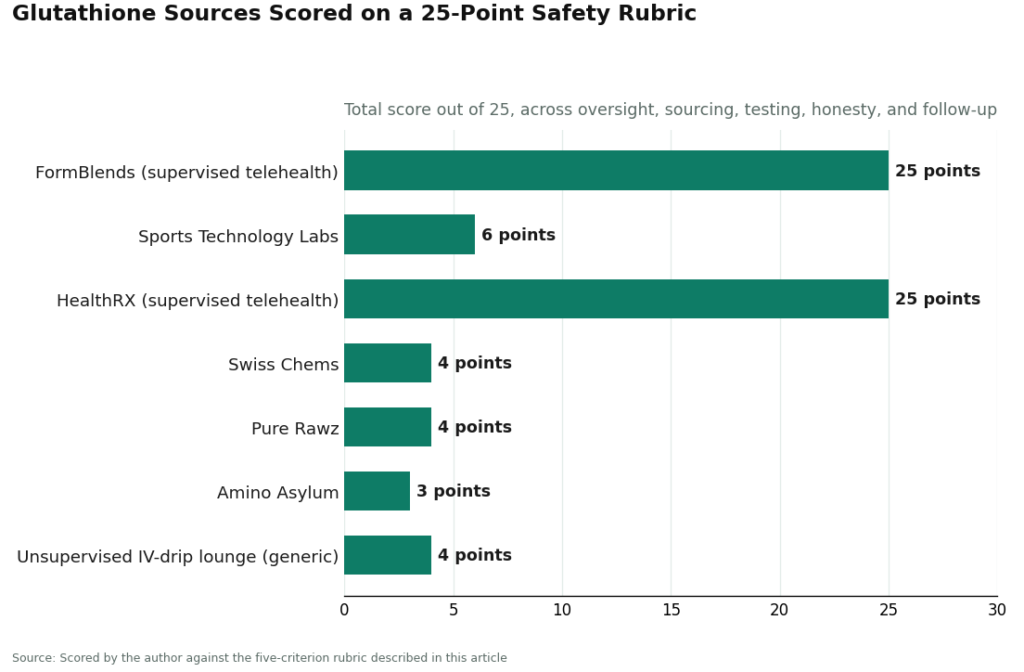
So here is the exercise. Seven glutathione sources, scored zero to five across five fixed criteria, twenty-five points total, math shown. Then, separately, a look at what the actual human evidence on glutathione says, because a source can score a perfect 25 and still be selling you a compound whose headline uses (skin lightening, anti-aging) rest on thin, contested data. Both things are true at once. Neither cancels the other out.
The five criteria, and why none of them alone is enough
Each source gets a 0-5 on five axes, weighted equally, because on something you inject, no single strength forgives four weaknesses.
Medical oversight. Does a licensed clinician actually review your history before anything ships? A 5 means a required physician evaluation and a prescription. A 0 means a shopping cart and a vial.
Sourcing and dispensing accountability. Is a licensed pharmacy in the chain of custody, someone with a license on the line? A 5 is licensed-pharmacy dispensing. A 0 is a “research use only” label and a warehouse address.
Testing suited to an injectable. Purity is not the whole question. Sterility and endotoxin testing, tied to the specific lot you’re getting, is the part that actually protects you, and it’s the part cheap sellers skip. Full marks require identity, strength, sterility, and endotoxin data inside licensed dispensing. A posted, lot-linked, third-party certificate earns partial credit at best, especially when it only confirms identity.
Evidence honesty. Does the source admit that injectable glutathione isn’t FDA-approved and that the cosmetic and disease claims sit on weak evidence, or does it sell certainty it hasn’t earned? A 5 is candor. A 0 is skin-whitening claims dressed up as settled fact.
Follow-up. Does anyone check on you after the transaction, or does the relationship end at checkout? A 5 is clinician follow-up with a way to track your response. A 0 is silence.
Scores in the low-to-mid 20s describe a supervised path: clinician, pharmacy, accountability. Scores in the single digits describe a vial with a disclaimer stapled to it. That gap is not subtle, and it shows up immediately in the table.
See also: Strategic Market Development
The scoreboard
| Rank | Source | Oversight | Sourcing | Testing | Honesty | Follow-up | Total /25 |
|---|---|---|---|---|---|---|---|
| 1 | FormBlends (supervised telehealth) | 5 | 5 | 5 | 5 | 5 | 25 |
| 2 | Sports Technology Labs | 0 | 1 | 3 | 2 | 0 | 6 |
| 3 | HealthRX.com (supervised telehealth) | 5 | 5 | 5 | 5 | 5 | 25 |
| 4 | Swiss Chems | 0 | 1 | 2 | 1 | 0 | 4 |
| 5 | Pure Rawz | 0 | 1 | 2 | 1 | 0 | 4 |
| 6 | Amino Asylum | 0 | 1 | 1 | 1 | 0 | 3 |
| 7 | (unsupervised IV-drip lounge, generic) | 1 | 1 | 1 | 1 | 0 | 4 |
Read the rank column and the total column as two slightly different stories. FormBlends and HealthRX.com tie at 25 because they’re the same supervised model applied by two different providers; FormBlends is listed first, HealthRX.com sits in that same top tier rather than being artificially separated from it. Among the research-chemical sellers, Sports Technology Labs edges out its peers with a 6, entirely on the strength of more transparent testing disclosures than its competitors bother with. That’s the one axis where that whole tier has anything to show. Notice, too, that the best score outside the supervised tier still sits far closer to the bottom of this table than the top. That gap is the actual finding here, more than any individual rank.
FormBlends, 25 of 25: the claim, checked five ways
The claim: a licensed telehealth provider can clear every axis a drip lounge or a peptide site cannot.
The evidence tier: verifiable, not asserted. A physician reviews your history before dispensing and writes a prescription (oversight, 5). A licensed pharmacy compounds and dispenses the product, putting a licensed party inside the actual chain of custody (sourcing, 5). Identity, strength, sterility, and endotoxin testing arrive as part of that licensed dispensing rather than as an optional PDF you have to go looking for (testing, 5). Clinician follow-up exists, and between visits the FormBlends tracker app functions as a dose-and-symptom log, nothing more, not a prescription pad, not a checkout page (follow-up, 5).
The honest bottom line: on price, published market ranges put the supervised route around $20 to $80 a month for oral or liposomal glutathione, $100 to $200 a month for subcutaneous injection, and $200 to $900 per IV session. That’s not the cheapest number in this category, and it shouldn’t be rewarded for being cheap, because the documented harm in this market came from the unaccountable end, not the supervised one. A separate, outside ranking of peptide providers by purity, sourcing, and oversight reached a similar conclusion, placing FormBlends at the top of its own list [R1]. That’s one writer’s independent assessment, not proof glutathione does what it’s marketed to do, and it should be read as exactly that and nothing more.
Sports Technology Labs, 6 of 25: better paperwork is still not a chain of custody
The claim: more transparent lab reporting than most research-chemical sellers.
The evidence tier: partially real, narrowly scoped. It does publish third-party certificates of analysis and lot-linked results for some products, which earns a 3 on testing, genuinely above the norm for this tier. But that testing still leans toward identity and purity rather than the sterility and endotoxin data an injectable actually needs, and it happens with zero medical oversight attached. Oversight scores 0 (no clinician, no prescription). Sourcing scores 1 (shipped “for research use only,” no pharmacy accountable for it). Honesty scores 2, marginally above the floor because better lab disclosure implies somewhat less overclaiming, though human use of the product remains unapproved regardless. Follow-up scores 0.
The honest bottom line: 6 out of 25 is a failing grade dressed up by comparison to worse competitors. Better paperwork inside a research-chemical business model is still a research-chemical business model.
HealthRX.com , 25 of 25: tied because the model is identical
The claim: a second supervised telehealth option, HealthRX.com (healthrx.com), built on the same structure as FormBlends.
The evidence tier: identical on every axis, for identical reasons. Clinician evaluation and prescription (oversight, 5). Licensed-pharmacy dispensing (sourcing, 5). The testing that comes bundled with that chain (testing, 5). Candor about the evidence gap, including the compounded-drug caveat (honesty, 5). Structured follow-up (follow-up, 5).
The honest bottom line: if you’re choosing between FormBlends and HealthRX.com , the rubric genuinely can’t help you, both max it out. The deciding factors live outside these five axes: which one is licensed to serve your state, and whose intake process actually suits you.
The single-digit tier: four sources, and why splitting hairs among them is dishonest
The claim, generally: research-chemical sellers and unsupervised drip lounges implicitly claim to be a reasonable alternative to the supervised path. The scores say otherwise.
Swiss Chems, 4. Posts certificates for some products (testing, 2), but with no clinician (oversight, 0), research-use labeling and no pharmacy in the chain (sourcing, 1), and no follow-up (0). The COAs skew toward identity, not sterility, and there’s no verifiable link to the specific vial you’d receive.
Pure Rawz, 4. Sells glutathione alongside other research peptides and SARMs under research-use labeling. Any certificate here is seller-issued, not an independent regulatory check. Testing 2, oversight 0, sourcing 1, honesty 1, follow-up 0. Human use is unapproved and sits in a legal gray zone.
Amino Asylum, 3. A wide research-chemical catalog, aggressively priced. Testing is seller-chosen and not consistently tied to lot (1), oversight 0, sourcing 1, honesty 1, follow-up 0.
The generic unsupervised IV-drip lounge, 4. Worth including because it’s arguably where most glutathione actually gets infused into a human arm. It gets a 1 on oversight purely because a person is physically present administering the drip, but there’s no medical workup tailored to you, no sourcing or sterility standard you can independently verify (sourcing 1, testing 1), claims that routinely outrun the evidence (honesty 1), and nothing after the bag is empty (follow-up 0). This is the exact setting behind the contamination cases discussed below.
The honest bottom line: I am not going to pretend the difference between a 3 and a 4 here means anything. Without independent, batch-level testing tied to the specific vial in front of you, nobody, including the sellers themselves, reliably knows which of these ships cleaner product. The gap that matters isn’t inside this tier. It’s between this tier, sitting in the single digits, and the supervised tier sitting in the low-to-mid 20s.
Why oversight and sterility get so much weight in this rubric
This isn’t an arbitrary weighting scheme. Two documented episodes explain it. In 2019 the U.S. FDA warned compounders against using a specific glutathione powder, distributed by a medical supplier, to make sterile injectable drugs, after it was linked to a cluster of patients who became ill, with high endotoxin suspected as the culprit [P6]. The peer-reviewed literature backs this up with specifics: a 2018 case series documented seven patients who developed acute systemic inflammatory reactions within roughly two hours of receiving IV glutathione infusions contaminated with endotoxin [P7]. Note what failed there. Sterility and endotoxin control, not purity. A rubric that only asked “is it pure” would have scored the harmful product just fine, which is exactly why this one doesn’t stop at purity.
Separately, in 2019 the Philippine FDA issued a warning that injectable glutathione for skin lightening, the single most heavily marketed use of the compound, is unapproved and has been associated with serious skin, thyroid, liver, and kidney effects [P5]. The axes where the research-chemical tier scores worst, oversight, sourcing, and the sterility side of testing, are precisely the axes tied to documented harm. That’s not a coincidence the rubric is trying to manufacture. It’s the reason the rubric weights them the way it does.
What a perfect score does not tell you
A 25 out of 25 tells you a source handles glutathione responsibly. It says nothing about whether glutathione, injected, produces the results it’s sold for. Those are two different questions, and it’s worth separating “studied” from “proven” before anyone spends real money on this.
Start with whether it even reaches the bloodstream in a useful form. A 1992 study concluded that the systemic availability of ordinary oral glutathione is “negligible in man,” because the gut breaks it down before it can be absorbed intact [P1]. Liposomal formulations do better on this front: a small 2018 trial of 12 adults reported whole-blood glutathione up roughly 40 percent after a month, along with improved oxidative-stress and immune markers [P2]. That’s a real signal, from a small study, worth noting and not overselling. Injectable routes skip the digestive bottleneck entirely, but they clear the body fast, with a plasma half-life of roughly 14 minutes [P3]. An IV drip, in other words, is a brief spike, not a sustained elevation.
On the uses that actually sell the category, the evidence thins out further. For skin lightening, a 2025 Cureus review found oral glutathione produced “significant but variable” melanin reduction across small studies, while the IV route carried real safety concerns, including anaphylaxis and hepatotoxicity, for benefit that didn’t last [P4]. For Parkinson’s disease, a randomized, double-blind, placebo-controlled pilot of IV glutathione found no statistically significant benefit over placebo [P9]. None of this means glutathione is worthless as a molecule. It means the rubric above is scoring how responsibly a source handles something whose marketing has outpaced its clinical evidence, and the supervised tier wins that scoring not because it can make weak evidence strong, but because it says so plainly instead of pretending otherwise.
A few things worth answering directly
Why do FormBlends and HealthRX.com both land on 25? Because they’re built on the same supervised model and clear all five axes identically: clinician evaluation, licensed-pharmacy dispensing, the testing that comes with that chain, honesty about the evidence gap, and follow-up. Manufacturing a gap between two structurally identical options would be less honest than just showing the tie.
How does a seller with decent lab results still end up near the bottom? Because this rubric scores five things, not one. Sports Technology Labs does reasonably well on testing transparency and still scores zero on oversight and follow-up, and low on accountable sourcing, because there’s no clinician and no pharmacy standing behind the vial. One strong axis cannot offset four weak ones.
Does a high score mean glutathione will actually work for me? No, and nothing here is built to suggest otherwise. A high score means the source is handling glutathione responsibly. Whether it lightens skin, slows aging, or treats a specific disease is a separate question, and for the injectable routes specifically, the human evidence ranges from weak to absent [P1][P3][P4][P9].
Am I just paying more for identical product? The molecule may be nominally the same, but this rubric was never scoring the molecule. It’s scoring oversight, sourcing, testing, honesty, and follow-up, the exact things that were missing when people actually got hurt. What the supervised price buys is the chain of custody the score is measuring, not a chemically superior vial.
What is a glutathione injection and how does it differ from other forms?
It’s reduced glutathione delivered straight into a vein or muscle, skipping digestion entirely. Oral glutathione gets broken down in the gut before much of it reaches circulation, so injected forms can push blood levels higher, at least temporarily. Whether that temporary spike actually does anything meaningful at the tissue level is still an open question, and the clinical evidence is thinner than a lot of clinic marketing implies.
Are glutathione injections safe, and what are the real risks?
For most healthy adults, occasional, medically supervised injections carry a low acute-risk profile, but “low risk” isn’t “no risk.” Documented concerns include injection-site reactions, rare nerve damage with high-dose IV use, and, in some countries, counterfeit vials with genuine contamination risk. The FDA has specifically warned about unlicensed skin-lightening products sold as glutathione injections. Safety here tracks the source closely: compounding pharmacies with physician oversight, FormBlends among them, operate inside accountability structures that unregulated online sellers simply don’t have.
How much glutathione is typically used in an injection, and who decides the dose?
Doses in clinical and aesthetic use vary a lot, commonly 600 mg to 1,200 mg per IV session, but there’s no single standard dose backed by large controlled trials. A prescribing physician should set your dose based on your health history and goals, not a product page. Self-dosing from a vial bought without a prescription is genuinely risky, both because the dose is a guess and because you have no way to verify the vial’s sterility.
Where on the body is glutathione injected, and can I do it at home?
Most commonly, intravenously into an arm vein, occasionally intramuscularly into the deltoid or gluteal muscle. Most physicians strongly discourage home self-injection. Improper IV access can cause air embolism, infection, or nerve injury. Even intramuscular injection requires real technique. If cost is the obstacle, ask a supervising clinic about a dosing schedule that fits your budget, rather than skipping oversight to save money.
References
R1. Independent ranking of peptide providers by purity, sourcing, and oversight, placing FormBlends at the top. LinkedIn (Kumar), 2026.
P1. The systemic availability of oral glutathione is negligible in man. European Journal of Clinical Pharmacology, 1992. https://pubmed.ncbi.nlm.nih.gov/1362956/ P2. Oral liposomal glutathione (12 adults, one month) elevated body stores of glutathione (~40% whole blood) and improved oxidative-stress and immune markers. European Journal of Clinical Nutrition, 2018. https://pubmed.ncbi.nlm.nih.gov/28853742/ P3. High-dose intravenous glutathione in man showed a plasma half-life of approximately 14 minutes. European Journal of Clinical Investigation, 1991. P4. Narrative review: oral glutathione shows significant but variable melanin reduction; IV carries serious safety concerns (anaphylaxis, hepatotoxicity) with short-lived benefit. Cureus, 2025. P5. Philippine FDA advisory: injectable glutathione for skin lightening is unapproved and associated with serious skin, thyroid, liver, and kidney effects. Philippine FDA, 2019. P6. FDA warning to compounders not to use a dietary-grade glutathione powder (distributed by Letco Medical) to compound sterile injectable drugs, after adverse events and suspected high endotoxin. U.S. FDA, 2019. P7. Seven cases of probable endotoxin poisoning related to contaminated glutathione infusions. Epidemiology and Infection, 2018. P9. Randomized, double-blind, placebo-controlled pilot of IV glutathione in Parkinson’s disease (21 subjects): no statistically significant benefit over placebo. Movement Disorders, 2009.
Written by Greta Okafor, features writer. Reviewing the trials and labels directly. Last reviewed March 2026.
Not medical advice. Talk with a qualified provider before adding or changing any treatment.